Parables about a wrong Attitude towards Grace

Updated: Jul 2
I tell you that in the same way, there will be more joy in heaven over one sinner who repents than over ninety-nine righteous persons who need no repentance.
—Luke 15:7

Titles of Parables
The parables in Scripture have no titles. Most Bibles use titles for parables, added by the translators/editors as overheads. In the case of 'the parable of the sower' (P1), Jesus used these very words when He gave the interpretation (Matthew 13:18), yet not so much as a title but rather as a description. Jesus also spoke of 'the parable from the fig tree' (Matthew 24:32). Most parables, however, have no titles, and they don't need titles. What is important in the parables is the meaning, the point Jesus was making in His parabolic teaching. Titles in Bibles are helpful for easier orientation, but are not part of the inspired Word of God. Hence, we can reconsider them or perhaps ignore them in case they guide our reading and understanding of a parable in a way that might miss the point Jesus was making or miss the full meaning of the story. And this is because titles/headings already shape our approach to Scripture, how we read it, and we should take great care to be as objective and honest towards the text as possible (see Introduction to the Parables).
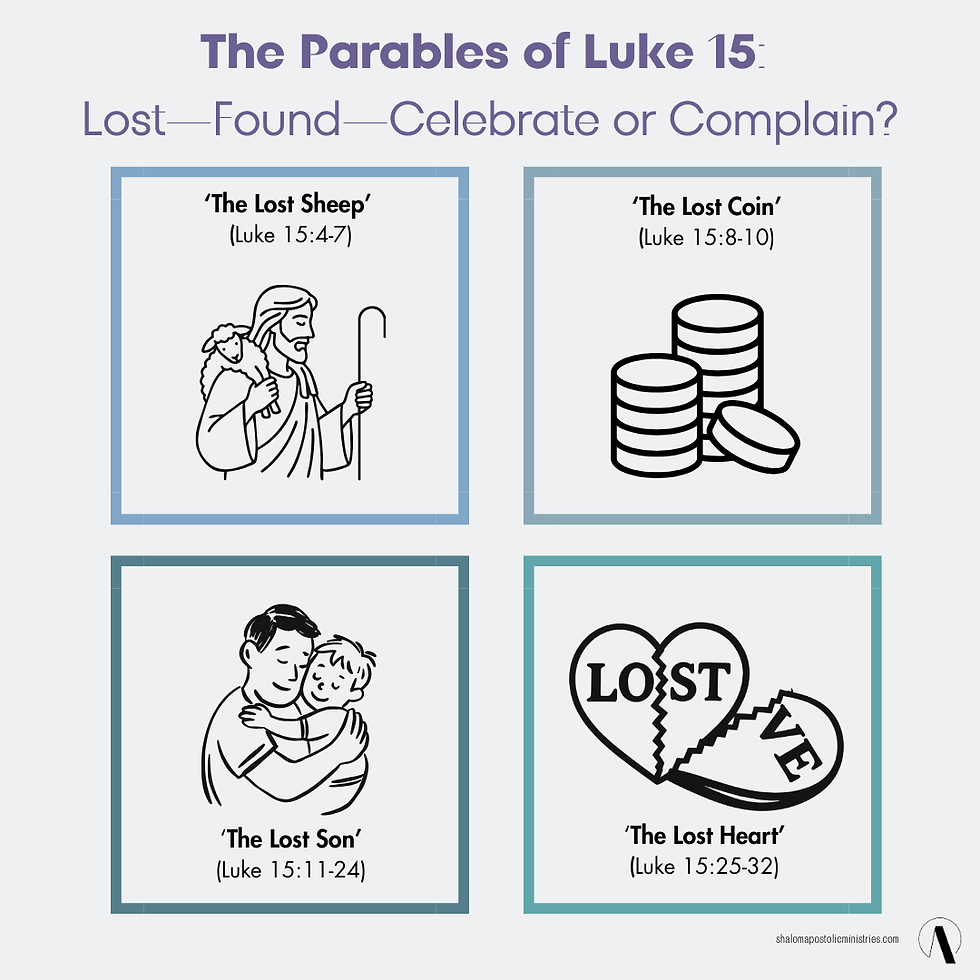
The title or titles for the parables in Luke 15 are a case in point. The Lost Sheep, the Lost Coin and the Lost Son are certainly helpful titles and capture the idea that something or someone was lost and then found, followed by a celebration. The Prodigal (wasteful) Son is another well-known title for the third parable here. Or, a Father with two lost sons, also reflects the content of the parable, that is, one was lost in sin, the other lost in religious, resentful self-righteousness. Yet do these titles or overheads accurately reflect the point Jesus was making? There is a reason, as will hopefully become clear here, why the title of this article deals with 'a wrong attitude towards grace.' But titles are not as important as the content. So let's have a look at the text of Scripture.
Context and Audience
As in all biblical interpretation, context is key to understand the text. A verse out of context can greatly distort the meaning and miss the point completely. In Luke 15, the opening verses describing the audience Jesus was speaking to, are the first hints at understanding the point He was making.
Then all the tax collectors and the sinners drew near to Him to hear Him. And the Pharisees ad scribes complained, saying, "This Man [Jesus] receives [welcomes] sinners and eats with them." So He [Jesus] spoke this parable to them, saying:
—Luke 15:1-3 NKJV
There were two groups of people that make up the audience. The sinners on the one hand, and the religious people, who complained about Jesus welcoming sinners and dining with them, which was a sign of acceptance, on the other. In a previous incident (Luke 5:27-32) Jesus was criticised for accepting sinners and fellowshipping with them. The religious folk complained. Jesus was known as a 'friend of sinners,' which was a slur against Him (see Q6). Keep that in mind. The following infographic illustrates the audience and corresponding characters.
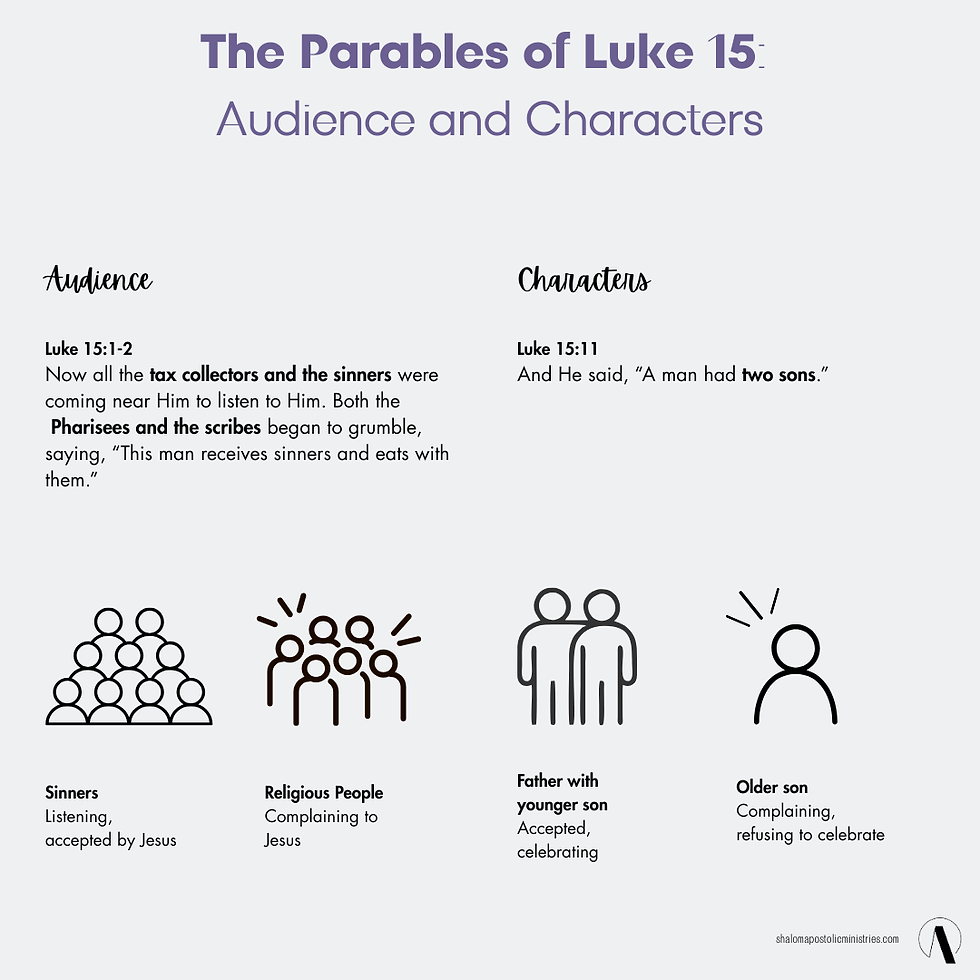
The parable of Jesus comes as a direct response (v 3) to the complaining of the religious people against Jesus welcoming sinners (v 2). This is vital for our understanding of the parable. Note that 'parable' is in the singular, not plural ('parables'). We can certainly see them as three parables, yet they are interconnected. We suggest that the first two serve as a kind of prelude to the third one. Note also the similarity in the first two parables and the first half of the third parable: something or someone was lost, then found, followed by an invitation to celebrate. Jesus concluded twice (vv 7, 10) that there is joy in heaven over sinners who repent, referring to the first group in the audience, yet sending a message to the second group, the 'complainers,' in the audience. The lost sheep and lost coin represent repenting sinners who are saved. A celebration is in order as the appropriate response.
The Parable about a Wrong Attitude towards Grace
As stated above, titles or overheads are man-made. You can take this title with 'a pinch of salt,' that is, evaluate it or ignore it for now. At the end we suggest yet another title that describes the message of the parable in human words. As you set out to study Luke 15, kindly read the whole chapter before continuing reading here. It serves for a better understanding. Take notes as you read.
A Summary of the Parable
The first part (Luke 15:4-6) is about a sheep that was lost (one of a hundred sheep, hence 1% of the flock), is then found, followed by an invitation to celebrate the return of the lost sheep (v 6). Jesus concluded that there is great joy in heaven over a repenting sinner (v 7). Note that Jesus puts the opening statement of the parable in question-form (v 4), implying an affirmative response.
The second part (Luke 15:8-9) is about a woman who lost one of her ten silver coins (10% of her monetary wealth), then finds it, and extends an invitation to her friends and neighbours to celebrate. The conclusion here (v 10) is the same as before: let's celebrate! Again, the opening statement is in question-form, implying an affirmative response.
The first half of the third part (Luke 15:11-24) is about a father with two sons who divides his wealth among them after the younger sons asked for his share. The older brother is silent. The younger one sets out into the world, wastes his money and finally returns to the father, who receives him back with joy and arranges a celebration. The elder brother, however, complains and refuses to join the celebrations.
Interpretation of the Parable
The lost sheep that was found (Luke 15:4-5) speaks of the repenting sinner who is 'found' and has returned home (v 7). The invitation in the parable (v 6) is Jesus' indirect invitation for the complaining group in the audience to join the celebration over repenting sinners. Peter later wrote of Jesus as the 'Shepherd and Guardian of your souls' to whom we have returned (1 Peter 2:25) based on His sacrificial love in the cross, a salvation that makes us forsake sin and live for righteousness (v 24). Interestingly, Jesus puts the opening statement of the parable in question-form (Luke 15:4), evoking an affirmative response: what shepherd would not seek out his lost sheep and then celebrate? Implicit answer: only a heartless one.
Elsewhere, Jesus used this illustration in parabolic form of a lost sheep found by the shepherd to make the point that God does not want anyone to perish (Matthew 18:12-14). The context there speaks of humility as greatness in the kingdom of God (vv 1-6; see Q5) and a stern warning not place stumbling blocks in front of the humble, represented by a child (vv 7-11). Jesus came to save sinners (v 11; cf., Luke 19:10; 1 Timothy 1:15).
So it is not the will of your Father who is in heaven that one of these little ones perish.
—Jesus (Matthew 18:14)
Paul would later state that God wants all human beings to be saved and come to the knowledge of the truth about Jesus the Saviour (1 Timothy 2:3-7; cf., 2 Peter 3:9).
The lost coin that was found (Luke 15:8), followed by an invitation to rejoice over it (v 9) and Jesus' conclusion that there is joy in heaven over a sinner who repents (v 10), communicates the same message: the lost coin represents the repenting sinner who has been 'found,' and a celebration is in order. It is, a second time, an indirect invitation for the complaining group to join the celebrations. And again, the opening statement is a question: who would not seek the lost coin until it's found and rejoice? Implicit answer: an indifferent person.
Both the seeking out of and finding the lost sheep and the lost coin are followed by a celebration which is the only right action and appropriate response. There is a strong emphasis on 'rejoice with me' and 'joy.' In both cases there is great effort and persistency 'until' the lost sheep (v 4) and coin (v 8) are found. The parable of the lost coin is unique to Luke's gospel, yet the parable of the lost sheep is found in Matthew (18:12-13). However, the difference in the two gospels in applying this parable is that in Luke the focus is on repenting sinners and in Matthew on not offending and misleading others (Matthew 18:14), especially humble and vulnerable children (vv 1-6, 10).
The lost son who was 'found' by returning in repentance to his father (Luke 15:11-24) makes up the first half of the third parable. It communicates the same main point as the previous two parables, only this time, it is neither an animal nor an item of monetary value, but a human being. Hence, of much more value in the biblical worldview. The father extends grace by welcoming him and restoring him despite his seriously sinful and wasteful lifestyle. The son was 'dead' and 'lost,' but now 'alive' and 'found'—and 'they began to celebrate' (v 24). The celebrations (vv 6, 9, 24) correspond to the joy in heaven (vv 7, 10) and are supposed to be the natural response to grace and salvation.
The emphasis on 'rejoicing' and 'joy' of the first two parables is implied here by the celebration over the returned son. Jesus did not add the concluding remarks about joy in heaven over repenting sinners a third time; it is self-explanatory by now. The people got the message. Yet after that the parable takes a striking twist as the expected, natural response by the older brother is not joy, but complaining...

The older son is the focus point of the rest of the parable (Luke 15:25-32). He is mentioned at the beginning (v 11), since the father had 'two sons,' among whom the father 'divided his wealth' (v 12). That means, both got their share of their inheritance, and, according to Jewish law, the first born gets a 'double portion.' Hence the 'wealth' of the father was divided 2/3 and 1/3 among the two sons. It is stiking to point out that asking for an inheritance while the parent was still alive was an insult of the worst kind in a society where honouring parents was of utmost importance. It is, in other words, saying that the son would rather have the father drop dead and take the money, than have a relationship with him. Money mattered more than a parent! What is striking beyond that is that the older son was silent. As the older, more mature one, he was expected to take the younger, foolish brother aside and 'sort him out,' so to speak. But he didn't. He, too, wanted his money, but hid behind silence. It was a total breakdown of a family despite having a loving father. It was a real-life scenario.
Interestingly, in the common practice at the time, as long as the father was still alive, he was still in charge of the estate and its finances. This means, everything belonged to older son, yet the father was still in charge, safe-guarding against a possible misuse of the distribution of the pre-inheritance arrangement, with potentially leaving the generous parent destitute. The young brother wasted all his money, over which the father had no authority since he was far away. The older son's inheritance, under the authority of the father, was available: the party given to celebrate the prodigal son's return was paid for by the inheritance of the older son. He was neither joyful nor generous, despite his father's example. In Jewish thought, to repent is to 'come home.' The younger brother came home where he belonged. So did the repenting sinners. Jesus welcomed them with love, forgiveness and acceptance, and so should we. Is this to down-play the gravity of sin? Not at all; it is to highlight the power and beauty of grace, forgiveness and love.
The striking part of the parable, and that is its climax, is the older son's complaining reaction against the generosity and grace of the father towards his younger brother. Instead of joining the celebrations, he got angry and refused to join (v 28). His focus was his own good deeds (v 29) and the sins of the brother (v 30), although the father had been equally good and generous to him. Even the father's explanation and invitation didn't help to change his negative attitude towards the father's grace (vv 31-32) or towards his brother, or, as he called him, 'this son of yours' (v 30), refusing to call him 'my brother.' Although his brother 'came to his senses' (he understood that he was wrong and what was right) and returned home (vv 17-18), his brother couldn't accept him. This speaks of a wrong heart towards sinners who come to their senses and turn away from a sinful life. It is one thing to be upset his brother wasted his money and lived a sinful life, yet another things to be upset with him after his repentance. It's one thing to have a negative attitude towards people doing wrong things, but another thing to condemn those who changed. The emphases in the parables on joy and the invitations to celebrate, highlight the older son's refusal to rejoice and celebrate. He missed what is important in life. He rejected his brother based on his sins and refused to rejoice over his return and the father's restoration of his brother. He rejected his father's goodness and invitation to rejoice by refusing to acknowledge the grace extended to his brother by his father. He had, as it appears, a 'lost heart.'
The Conclusion of the Parable
The thrust of the parable points towards the wrong attitude towards grace by the older son who was complaining instead of rejoicing and celebrating. It should be clear by now that the two sons represent the two groups in the audience: the repenting sinners (the 'lost yet found' group) and the religious elite (the complainers who refuse to rejoice at grace being extended to sinners). The point of the parable is that not rejoicing at repenting sinners as God, the loving Father does, is wrong and exposes a wrong attitude towards grace.
Jesus addressed the 'lost heart' of the elder brother who represents, as illustrated in the parable, the religious folk who complained at the return of the repenting sinners instead of rejoicing in celebration over their repentance and 'being found' and 'made alive'—as heaven is! There is something seriously wrong when one cannot be happy over a person who leaves the wrong paths in life and receives grace by God. Perhaps we should call it the 'Parable of the Lost Heart' as it exposes a wrong attitude towards grace. The father was gracious, the people rejoiced, yet the brother complained—and that's seriously wrong. Unlike the first two short parables, this third one has no concluding remark by Jesus. It doesn't need one. And that is the power of the parable—nothing more needs to be said
Someone may say, as syblings often do, 'but it's not fair!' The younger one deserved punishment for being sinful and the older one a reward for being good. This understanding would imply that grace is a failure of justice. That would be true if God forgave everybody just like that, yet the parable, as many other incidents in the life of Jesus, is about repenting sinners. Think of Zacceus (Luke 19) or the woman caught in adultery (John 8). But grace is not random; it is given to the humble. Grace is not contrary to justice; grace reflects God's generosity, love and goodness, and His will that all people should be saved and come to the knowledge of the truth—that God is a loving Father who forgives a repenting sinner no matter what he or she has done! Jesus died to save sinners (Romans 5:6; 1 Timothy 1:5). Failing to see this, is failing to understand God. After all, we are all sinners in need of forgiveness. We all fall short of the glory of God but can be saved by the free gift of God's salvation in Christ (Romans 3:23-24). Solomon wisely observed that ;there is no man who does not sin' (1 Kings 8:46). We fool ourselves if we deny it (1 John 1:8). Seeing the speck in others but failing to see the beam in our own eyes (Matthew 7:3-5) is a remarkable phenomenon!
Application of the Parable
How does this parable strike you? People usually fall into one of the two groups: the sinners who 'messed up,' yet repented and received grace—and rejoiced!—and the religious complainers who cannot accept God's grace for sinners. The 'neighbours; who were invited to celebrate are in the rejoicing, not the complaining group. There are basically two groups of people who have either a humble heart to repent and rejoice, or a cold heart that refuses to. Of course, there are also sinners who don't care about God and His standards, but that's not the point here. The self-righteous and proud religious folk who would rather boast of their own achievements, want to show others how and why they qualify for God's goodness and blessing, and how others are beyond the reach of God's grace and therefore unworthy of it. They see the speck in other people's eyes, yet fail to see the beam in their own eye (Matthew 7:3-5), hence they are judgmental (vv 1-2), not gracious. Even if there is only a speck in their eye and a beam in others, they still find fault rather than extend grace. This is a wrong attitude towards grace.
How do we apply the point of this parable? We should 'look in the mirror' (humble self-reflections) and not 'out the window' (proud criticism of others). It is a fascinating fact of human behaviour how we internalise success ('I did it,' 'because I'm so clever'), but externalise failure ('It's not my fault, but ...' my parents', or teachers', or whoever else's fault, someone we can blame!). Jesus was a friend of sinners and extended mercy to repentant sinners (see Q6). He wants us to extend the mercy and forgiveness we received to others and be gracious and kind (see P10). The prodigal son knew he was unworthy, yet the father never 'rubbed it in.' He embraced him; he accepted him; and he restored him—and that's how Jesus treated repenting sinners, and so should we.
If we find in ourselves a hardened and judgmental attitude towards repenting sinners (or sinners in general), perhaps we have forgotten what sinners we were or perhaps never realised it (see P4). Either way, we are to be merciful even as God is merciful (Luke 6:36). If we cannot rejoice at God's grace towards sinners, we have a wrong attitude towards grace and towards God who extends it—a hardened heart is a lost heart, not the heart of God.
Final Remarks
The third parable is generally known as the 'Parable of the Prodigal Son,' and often only the first half is preached to show how much God loves people in general and sinners in particular, like the good father in the parable loved his sinful and wasteful son. Emphasising the love of God is good and important, yet to the hearers at the time, it was a biblical truth they already knew. People knew that God is good and forgives a repenting sinner. The Temple worship and priestly arrangements was centred around sacrifice for the forgiveness of sin. This makes the conclusion of the parable all the more striking: they knew that God is good and forgives sinners, yet still refused to rejoice over it when Jesus showed them the love of God in action!
What is not right in the application of half a parable is that it misses the main point Jesus was making: the wrong attitude towards grace by those who refuse to rejoice over repentant sinners.
P7 >


Comments