The Parable of the Sower

Updated: Jun 15
And He [Jesus] was teaching them many things in parables, and was saying to them in His teaching...
—Mark 4:2

Introduction to the Parable
The Parable of the Sower (Mark 4; Matthew 13; Luke 8) is arguably the best parable to start a study of the biblical parables, for it is straight forward and Jesus Himself gave the interpretation of its meaning. Further, if we don't understand this parable, Jesus asked, how can we understand all others? (see Mark 4:13). This parable is, therefore, foundational to our understanding of what Jesus came to do, how to read and understand the parables in general, and how people responded to His message (see Introduction to the Parables for a right approach to these brilliant stories).
We encourage the reader to first read the biblical text(s) for each study and have the Bible at hand for further reference. Taking notes is also important in studying the Bible.
The Parable of the Sower
The Parable of the Sower appears in all three Synoptic Gospels (Mark 4:2-20; Matthew 13:3-23; Luke 8:4-15). The main message is the same in all three; the details that differ enrich our understanding of what Jesus was communicating to His disciples and the crowd. The context, especially the teaching that follows the parable, sheds further light on the parable and its interpretation.
It is important to emphasise that this parable was interpreted by Jesus Himself. This is a rare exception as parables are rather 'caught' than 'taught.' That is, if you don't get it when you first hear it, you might miss the point and its impact (the same principle applies to a joke: a joke is never as funny after missing the point and having it explained). Most parables have no explanation or interpretation; their meaning should be self-evident. However, since Jesus explained some of His parables, notably the Sower, and the disciples were instructed by it, the learning effect after explanation and interpretation works. The same applies to us.
However, one of the reasons Jesus taught in parables was related to a divine pronouncement by God to Isaiah for God's people regarding the condition of their hearts (see Isaiah 6:9-10). Jesus quoted some of these words (Matthew 13:14-15; Mark 4:10-12; Luke 8:9-10) in an allusion to the time of Isaiah and the sinful attitude of many among God's people, which prevented them to have spiritual understanding of the things of God and live lives pleasing to God. Jesus is pointing to the fact that our attitude towards God and His Word is vital in terms of spiritual understanding. Having a dull, indifferent or hardened heart, makes our eyes weary of hearing and our eyes blind, and ultimately prevents healing through an understanding heart, hearing ear and seeing eye (Matthew 13:15). The disciples were blessed for seeing what they saw and hearign what they heard (vv 16-17). Whoever had ears to hear, heard (v 9). This exhortation to hear, underlines that the issue at hand was the condition for proper hearing which leads to accurate understanding. The condition of the heart was vital in terms of spiritual understanding. After the fourth of Matthew's seven parables, a further quote from the Hebrew Bible, this time from the Psalms, is given to explain why Jesus taught in parables (Matthew 13:34-35; Psalm 72:2). Similar to the quote from Isaiah, this passage again refers to the attitude of those hearing God's word: the rebellious and those who are not steadfast won't have spiritual understanding; those, on the other hand, who choose humility will understand God. We have explained this elsewhere in more detail (see Q2).
This doesn't make the Word of God mystical in a Gnostic or New Age sense, but shows that God requires humility in the hearts of His people who want to understand Him and His will and ways. After all, the fear of the LORD—a healthy reverence towards and teachable humility before God—is the beginning of wisdom, knowledge and understanding (see Q7). Brad H. Young explains that 'a difficult to understand parable should not be considered secret teaching... the purpose of the parable was to instruct and not to conceal Jesus' message' (Jewish Parables, 7). The parables serve to reveal, not conceal. It must be pointed out, that often the original audience all too well understood what Jesus was saying, especially when it was about them (e.g., Matthew 21:45; Luke 7:40-43; 10:36-37).
The following infographic demonstrates the parable of the sower and its interpretation by parallel illustration. The left column are the words of the parable; on the right its interpretation by Jesus.
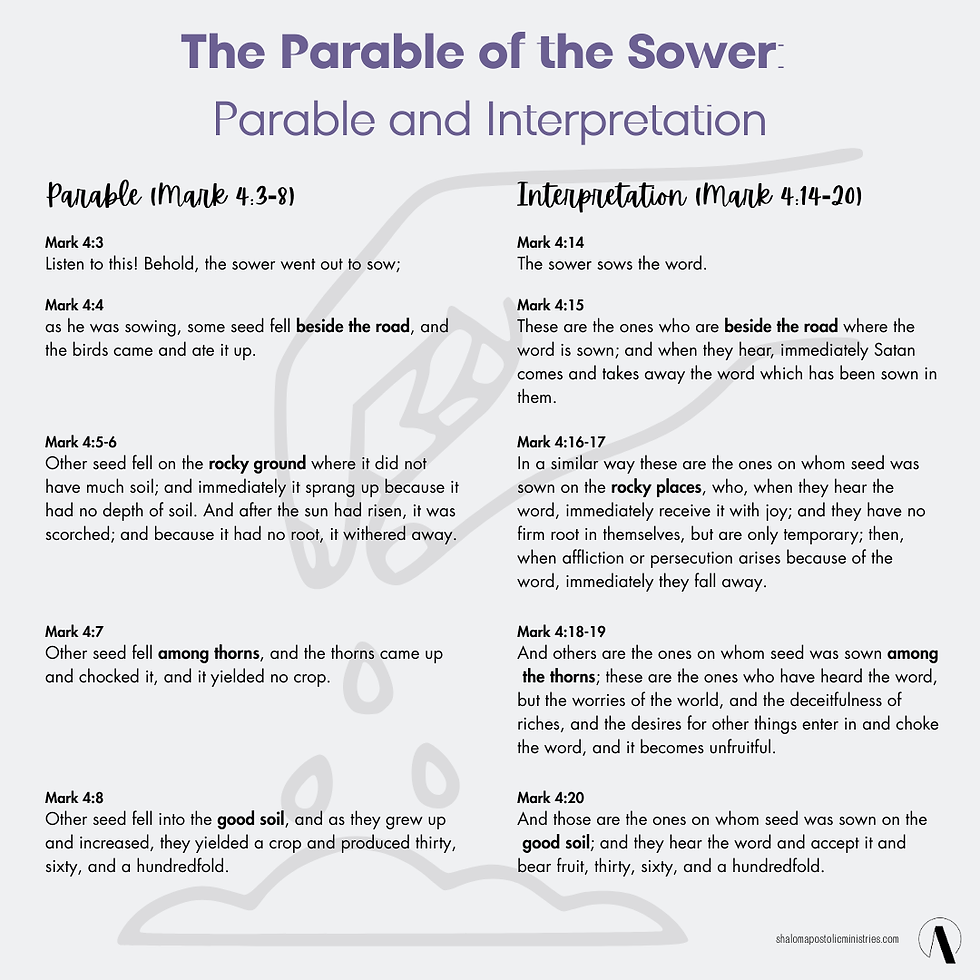
The first thing to notice is how the parable (Mark 4:3-8) has its interpretation (vv 14-20) given by the speaker (Jesus). His is the proper interpretation. Note the introductory line in Luke's account before the interpretation: 'Now the parable is this' (Luke 8:11a). In other words, this is what it means. Matthew's record introduces the interpretation with 'Hear then the parable of the sower' (Matthew13:18). In other words, hear its meaning. We may note that calling this parable 'the parable of the sower' matches Jesus' words. The speaker determines the meaning. The disciples had inquired regarding the meaning and Jesus gave it to them. Interpretation is no 'guessing game.' This might seem self-evident to some, but as we have explained in the Introduction to the Parables, some freely interpret parables as they wish or see fit. This can lead to serious misunderstandings, and, worse, misapplications. We cannot assign random meanings to the whole or parts of the parable. The meaning is determined by the speaker. Deviating from it would lead to a wrong interpretation. A wrong method can never bring a right result (see B6).
In the parable, the 'seed' is the word of God and the 'soil' is the heart of the hearers. They heard the word that 'has been sown in them' (Mark 4:15), or sown in the heart (Matthew 13:18), from where it was snatched (Luke 8:12). The illustration is striking: words are like seeds; this is true for all communication. We hear things in words and they form thoughts and emotions in us; some create memories, especially as words come to us in a certain context accompanied by action. We remember some and forget others. We tend to reject things we don't understand; sometimes we abandon things we initially liked; or we allow other things to replace what we first received. And then there are words that lead to decisions followed by action that we stick to. What is true of our response and processing of the word of God, is true for other aspects of life, too. That's why this parable is foundational: how we respond to God's word will determine the result (fruit); and, by extention in principle, what we make of our lives will show in the outcome.
To illustrate the parable and its interpretation in a different way, here are the 'four types of soil' where 'the seed' fell. It is clear that these refer to the condition of the heart of the hearers, as well as four ways of processing the word of God, that is, how they responded to it, what they did with it. The same applies to us.

The 'Soil of our Hearts'
The illustration Jesus used is one from agriculture. Jesus did not teach how agriculture works; rather He used it as a way of illustrating something about life. A seed must be sown in the soil to bring forth fruit. We all know that a seed needs soil to grow in. It can't grow on rocks or beside the roads without soil. Among the thorns, seed will be choked. This was, and still is today, a simple yet powerful way to draw a parallel to our lives: what we receive, what we do with it and what result it has. The 'roadside,' the 'rocky ground,' and 'thorns' and the 'good soil' are four ways of listening to, processing and responding to the Word of God. The result of what we hear is determined by the way we listen, process and respond to the Word, and ultimately what we do with it.
The traditional way to look at or describe this parable is the 'soil of our hearts'; in other words, on what 'soil' (i.e., the heart) does the word fall. This is a very good way of looking at it, yet we see from the emphases of both Matthew and Luke that it is more than the soil of the heart—it's what we do with the word, how we process it and how we respond to it. In order to bear fruit we must hear, accept (Mark 4:20) and understand the word (Matthew 13:23) with an honest and good heart and bear fruit with perseverance (Luke 8:15), rather than to allow temptations, worries, riches, pleasures (Luke 8:13-14; Mark 4:18-19), or even afflictions or persecutions (Mark 4:17; Matthew 13:21) to cause us to fall away unfruitful. The aim of planting a seed is for it to grow and bear fruit. And so is the idea of God sowing the seed of His word into our hearts that we receive and care for the divine seed and grow and bring the seed to fruition by bearing fruit.
Luke makes clear that the seed is the word and that it is sown into the heart of people who listen (Luke 8:11-12, 15). Matthew stated how it is about how a person receives and responds to what is sown ('the one on whom... this is the man,' Matthew 13:20, 22, 23) in relation to our understanding of the word (v 19). The 'rocks' and 'thorns' speak of things in life that affect us in relation to the growth and fruit of the seed. Even when we receive the word with joy, we can allow other things to 'choke' the word and it becomes unfruitful, that is, we are distracted from what really matters in life: to hear the word and apply it in order to bring forth fruit. What is sown in our hearts can be snatched away, become unfruitful or get choked, all of which results in bearing no fruit. The 'thorns' of worry, pleasures or riches, and even afflications and persecutions, can lead people to compromise with regards to God's word and its purpose to bear fruit. Hence, the farmer clears his field and removes the weeds. The same applies to our hearts, souls and minds. The following infographic illustrates this.

A Comparison of the Synoptic Gospels
Looking at all three versions of the parable and its interpretation, it's clear that the seed represents the word of God that Jesus spoke and people heard.

There is nothing mystical about this straight-forward illustration of this story parable. People were familiar with agriculture and understood the purpose of sowing and the necessity of good soil. Jesus used it to illustrate the 'sowing' of God's word in the hearts of people (note how often 'the word' is repeated), and shows what can go wrong depending on the 'soil' and what people do with what they heard. The 'word of God' (Luke 8:11) and the 'word of the kingdom' (Matthew 13:19) are the same things: what Jesus spoke about the heavenly kingdom as the word of/from God.
Seed beside the Road

If seed doesn't fall into the soil, it gets eaten by the birds. The illustration is the demonic activity to prevent the seed from flourishing in the hearts of people. The use of the following words, 'Satan' (in Mark), 'the devil' (in Luke), and 'the evil one' (in Matthew), are three different ways of speaking of the same demonic spirit hindering people from understanding God and His word. There is nothing demonic about 'birds' here; it's simply an illustration that shows what happens with seed that didn't fall into the soil: instead of the seed bearing fruit for the farmer, it becomes food for the birds; that is not the purpose of the seed. Luke points to the fact that seed in our hearts should cause faith and salvation (8:12). Matthew emphasises the problem of not understanding the word and thus being robbed of it (13:19).
Seed on rocky Ground

Rocky places lack soil for roots to grow and thus provide everything necessary for growth. Seed withers away in the scorching heart of the sun. Luke speaks of 'temptation' (8:13) and Matthew (13:21) and Mark (4:17) of 'affliction or persecution' because of the word. Afflictions or persecutions can make us or break us, bring the worst or the best out of us. Some people want to live for God only when everything is comfortable and good, yet reality on earth is not so. If we want to bear fruit, we need to deal with all challenges of life in the right way.
There is nothing demonic about 'the sun' (as with 'the birds'); this is simply a natural illustration for the purpose of what Jesus is teaching through the parable. One may hear and receive God's word with 'joy', yet the lack of a 'firm root,' which makes the seed unfruitful. Note Luke's emphasis that bearing fruit requires 'perseverance' (8:15). The 'temporary' nature of those who 'fall away' is a problem (Mark 4:17; Matthew 13:21).
Seed among Thorns

Thorns, like weed, choke other vegetation. It has a destructive nature. Again, people hear, and even receive the word, yet other things that are part of life choke the Word of God: worries, the deceitful aspects of wealth (when it has a wrong priority in our lives) and pleasures (sinful ones or even decent ones yet in excess) are destructive to growth and fruit-bearing. As a gardener removes weed and a farmer thorns, so we must remove from our lives anything destructive or hindering to our growth and fruit-bearing.
Seed on good Soil

The 'good soil' represents the right conditions for and handling or processing of the Word of God in our hearts. We need not only 'hear' but 'accept' it (Mark 4:20), 'understand' it (Matthew 13:23) and 'hold it fast,' which is 'perseverance' (Luke 8:15). For the seed of the word to flourish and bear fruit, we need 'an honest and good heart' (Luke 8:15). The multiplication of the seed transformed into fruit depends on the soil it grows in. The multiplied result of the seed in good soil points to the quality of the soil.
Four Ways to Process the Word of God
The traditional way of looking at this parable (the 'soil of our hearts') is good and right, yet a closer look at the emphases of both Matthew and Luke show that it's more than the soil of the heart—it's what we do with the word, how we respond to it, and how we process it. The types of people in this parable who all heard the word, differ in their response to it and what they did with it. Some didn't understand it, others received it yet remained unfruitful nonetheless. Jesus is teaching us that how we receive and process the Word is crucial for its purpose of fruit-bearing. The allusion to Isaiah's words speak strongly of the importance of humility before God and warn clearly of the destructive nature of a sinful lifestyle and wrong attitude towards God. Spiritual blindness is punishment as a result of sin. Spiritual sight is a blessing for being humble before God and seeking what is right in His eyes.
In both the Gospels and the Book of Acts, we see people having different responses and reactions to what they heard. Paul, for example, had those who sneered at him, others who wanted to hear him again, and a third group who believed in the message he preached (see Acts 17:32-34). When the Holy Spirit fell on the early church and people heard them speak in different languages speaking of the mighty acts of God, some were amazed, others mocked them (Acts 2:12-13), and after hearing Peter explain what was happening, many were 'pierced to the heart' (convicted and moved) and asked what they were to do (v 37). Steven's audience had a rather hostile reaction (Acts 7). Our response reveals or exposes our hearts.
Looking at the wider biblical context, repentance (D10), renewal of the mind (D11) and the process of sanctification (D12) are vital for growth. How we handle persecution (D13), suffering (D14) and the trials of life (D15) will determine how the seed will flourish. To be 'doers of the word' keeps us from deception (James 1:22-23) and living according to God's promises makes sure we won't stumble and be unfruitful (2 Peter 1:3-11). The purpose of the seed is to bear fruit; our hearts and the way we process the word are vital.
Root System & Fruit System
We see in nature how there is both a 'root system' (what grows downwards) and a 'fruit system' (what grows upwards and where the fruit grows). The infographic below illustrates this. What is visible is the result of what happened in what others didn't see. The good things we do in secret will be rewarded in the open (Matthew 6:4, 6), just as the evil that is done in secret will be exposed in the open (Luke 12:3).
The parable of the sower focuses on the seed of the word of God and what condition it is sown into, and what we do with it in terms of growth. The purpose of a seed is to grow and bear fruit. There won't be any fruit if we either disregard the word ('beside the road'), abandon the initial receiving of the word ('rocky places'), or allow the seed of the word to be choked ('among thorns'). Fruit will result by those who receive the word and endure in the growth process as God's children in order to bear fruit ('good soil'). Seeds need soil to grow.
If we think of applying this principle to other aspects of life, studying in secret to gain a good education with exceptional grades, or training at sports to win the trophy, or putting in the extra hours at work when no one is watching in order to be successful, all points to one principle: what you do in private (root system) will show in public (fruit system). The result will reflect the efforts you put into developing your skills and talents. Life is about what you make with what you have. Every talent or opportunity is like a seed; you can develop it and reap good results or neglect it and have nothing to show for. It's up to you. This principle is ultimately about stewardship: how to you receive, process and steward the word of God and all you are given in life.
The root system will determine the fruit system. Seed can only grow in good soil. All disruptive and destructive elements must be removed. If you want to achieve academic success, you must remain focused at your studies. The scholar is forged in solitude. If you want to win the trophy, you must be dedicated to your training. If you want professional success, you cut out the noise and don't allow anything to distract you from your goals. The problem is that most people want the success (the result), but don't want to do what it takes to achieve it. If you care about the quality of your life (soil), the quantity (fruit) will speak for itself. Work on the internal and the external will become visible in time.

The Teachings that follow the Parable
Matthew 13 orders several parables after each other, the Parable of the Sower being the first one, all dealing with the kingdom of God in some way, illustrating the nature of the kingdom (see P3). In Mark and Luke, Jesus continues teaching on the importance of placing a light in its rightful place: to give light to those in the room; followed by an exhortation how hidden secrets will be exposed by the light (Mark 4:21-22; Luke 8:16-17). Both evangelists record yet another exhortation by Christ regarding listening:
'Take care what you listen to' (Mark 4:24a, emphasis added)
'So take care how you listen' (Luke 8:18a, emphasis added)
The importance of what we hear (content) and how we listen (attitude) are vital in the rightful processing of hearing God's word (or any content, for that matter). The example of the lamp that is to give light (Luke 8:16) points to the purpose of the object. A lamp that is misplaced can't fulfil its purpose. In the same way, the seed must bring forth fruit, the purpose it was sown for in the first place. Further, there is a multiplication of those who have (i.e., bear fruit) and the opposite effect of those who don't (Mark 4:24; Luke 8:18). This, at first, seems unfair, yet in context it makes sense: processing the word (the seed on good soil) brings more fruit, a multiplication and increase; rejecting the seed or allowing it to be robbed or choked will result in fruitlessness. Hence, the seed is not fulfilling its purpose: to bear fruit. It all depends on what we do with it.
Mark's arrangement continues with two other parables regarding seed and growth (4:26-32), presumably to further underline the principles of the Parable of the Sower, yet Luke's arrangement continues with the incident when Jesus' mother and brothers came to see Him while He was teaching, pointing to the essential truth that those who 'hear the word of God and do it' are His true family (Luke 8:19-21). And again some time later, 'blessed are those who hear the word of God and keep it!' (Luke 11:28)
In view of the above illustration of the Root System and the Fruit System, we see how important the aspect of processing the word is. Extending this principle to talents, we understand that the result of our lives depends a lot on what we make of it. We can hide our talent and never achieve anything, or we can develop it and fulfil our purpose. What you do in private (the invisible Root System) will be seen in public (the visible Fruit System). Taking care of the quality of your life (soil) will result in the quantity of what you do (fruit). There is power in a seed (potential), yet fruit (results) depends on what we make of it.

Called to Bear Fruit
John does not share the Parable of the Sower in the Fourth Gospel, yet he used another illustration from nature and agriculture to illustrate growth: the vine and its branches.
You did not choose Me but I chose you, and appointed you that you would go and bear fruit, and that your fruit would remain, so that whatever you ask of the Father in My name He may give to you.
—John 15:16
We are called to bear fruit. Abiding in Christ and doing what He told us, is the way. We are to hear and obey God's Word. At the fundamental level of our attitude towards God's Word should lie a humble teachability and a responsible process to allow God's Word to take root, cause growth and bear fruit in and through our lives to God's glory. The promise of answered prayer comes in the context of abiding in Christ, living for God's will and bearing fruit for His glory. We are encouraged to let our lights shine so that people see our good works and thus to glorify God (Matthew 5:16). We are to hear and do, and thus be wise to establish our lives on solid ground, withstanding the storms of life (Matthew 7:24-27), including the deceptions of false prophets, who are lawless people not doing God's will, recognisable by their bad fruit (vv 15ff). Every tree is known by its fruit (v 20), and so are true believers or false ministers respectively. If we want to be safe from deception and have stability in life, there is no alternative to obedience to God's Word. We are wise to follow His instructions and bear fruit accordingly. So, let your light shine, let the seed bring forth fruit, and thus fulfil your purpose on earth.
Jesus used the 'seed' as an illustration for His death and resurrection to glorify God's name (John 12:23-28). Once the seed is in the soil it can bear much fruit (v 24). His message was about laying down your life in following Jesus and to live for God's purpose and glory (vv 25-26). Although His soul was troubled over the impending suffering, He knew His purpose (v 27) and would glorify God's name (v 28). There is power in a seed. Sometimes life can look like all is lost (death), only to bring forth new life (resurrection).
Conclusion
The Parable of the Sower teaches that the word of God is like 'seed' falling on different kind of 'soil,' the hearts of people who hear His word. Whether or not 'fruit' (results) will come forth from the 'seed' (word) is up to us: how we receice, respond and process the word of God will determine what comes of it. There are many things that will render the word unfruitful. The problem is not in the seed but the soil. Good seed in good soil will bring forth good fruit. 'Good soil,' a receptive, teachable and obedient heart will bear fruit and guarantee understanding and spiritual sight. Multiplication will naturally follow.
Hearing the Word of God and obeying it is the way to bear fruit for His glory and be safe from heresy and deception as true children of God. The parable teaches stewardship of the word sown into us, just as, in an extended way, talents and gifts are entrusted to us. Life is what you make of what you received.
R2 >
_________
References
Brad H. Young, Jesus and His Jewish Parables: Rediscovering the Roots of Jesus Teaching. Tulsa, OK: Gospel Research Foundation, 1989.
_____. The Parables: Jewish Tradition and Christian Interpretation. Peabody, MA: Hendrickson Publishers, 1998.


Comments