New: 16 June 2025; Update: 14 July 2025
The Origin &
Inspiration of the Bible
2 Timothy 3:16

All Scripture is inspired by God and profitable for teaching, for reproof,
for correction, for training in righteousness.
2 Timothy 3:16 NASB
Taking a closer look at the origin and inspiration of the Bible shows that its origin is divine, its reliability can be trusted and the application of it is profitable. The accurate recording and careful transmission of God's words in Scripture are witness to divine inspiration. With over 40 authors, on three different continents, in three different languages and over a time period of around 1.500 years, the Bible is a remarkable book with a striking unity in diversity of genre and creative expression (see Infographics: The Bible). God spoke, God speaks and His Word matters.
In the Beginning was the Word
The Bible opens with the words, 'In the beginning God created the heavens and the earth' (Genesis 1:1) and how God repeatedly spoke to create and give life to all things (vv 3, 6, 9, 11, 14, 20, 24, 26, 29). The Bible doesn't explain the biological and chemical processes of creation, but rather presents an all-powerful God who created all things by the power of His word. Alluding to the origins of creation in Genesis by God's spoken word, the Gospel of John opens with: 'In the beginning was the Word [Logos], and the Word was with God, and the Word was God' (John 1:1). God created the world by His word and upholds all things by the word of His power (Hebrews 1:1-4). The psalmist states, in poetic manner, that 'By the word of the LORD the heavens were made, and by the breath [Spirit] of His mouth all their host'; 'For He spoke, and it was done; He commanded, and it stood fast' (Psalm 33:6, 9). In the Wisdom Literature of the Bible, God is figuratively personified as Wisdom in creation (Proverbs 8:22-31; cf., 3:19-20). These are the different creative ways the Bible coveys the one message about God as Creator: God created all things by His powerful words. His words matter. God's word is powerful (Hebrews 4:12). God displays His power through His words; He declares His being and will through His Word. For God's people, the words of God, preserved in the Word of God, was always of highest importance. God's people have a commitment to the Truth revealed by God. The Quran refers to Jews and Christinas as 'the people of the Book,' the Bible, which is an external witness to the importance and centrality of God's Word to Jews and Christians.
The apostle John makes the Christological claim that Jesus is the Word (Logos) through whom God created and gives life to all things (John 1:1-4). Hebrews affirms this idea (1:1-4) and Paul underlined it (Colossians 1:15-18). Christ's words are spirit and life (John 6:63), 'the words of eternal life' (v 68). The Logos concept John is alluding to, in both Jewish and Greek thought at the time and in philosophy in later times, speaks of the universal reason behind creation. God is the 'unmoved Mover', to use Aristotle's concept. The Logos is the creative mind behind creation and original information of creation—not an abstract concept, but a Person: Jesus Christ, who at the appointed time became flesh, that is, a human being (John 1:14), to reveal God in person (vv 15-18) and redeem humanity lost in sin (Galatians 4:4-7). The Word of God not only created all things, the Word (Logos) entered the world in the Person of Jesus to save and redeem. Jesus is Immenual, 'God with us.' God hasn't abandoned the world lost in sin. He came into it to create and recreate; He came to save what was lost! The Bible presents God as active in creation and active among humanity created in His image.
The third Person of the divine Trinity, the Spirit of God, was also present at creation (Genesis 1:2), in order to create according to God's words: to bring order into chaos, shed light into darkness and give life to all things. The original tohu vabohu ('formless and void') was turned into a 'very good' creation (Genesis 1:2, 31) by God's word and Spirit working together as God's two hands, figuratively speaking, in creation (according to Church Father Irenaeus of Lyon). The triune God created all things and gives life to all things. As 'Lord of heaven and earth,' He 'made the world and all things in it' and 'gives to all people life and breath and all things'—in Him we live and move and exist! (Acts 17:24-28). The earth is the LORD's, all its fullness (Psalm 24:1; cf., 1 Corinthians 10:26, 28).
John also tells us that 'the Word was God' (John 1:1). God and His Word are one. Yet John also states, that the Logos was with God, pointing to a distinction of person within the unity of God. The Godhead is one substance in three persons. John then tells us that the Word became flesh (a human being) through whom we can understand God (vv 14-18). Jesus Christ is the incarnate Word of God who came to explain God to us and reveal His divine glory. God not only spoke words to create all things, He became man in the incarnation of the Word to speak to us. Jesus is Immanuel, 'God with us' (Matthew 1:23). God is the Word who became flesh in Christ. The Word that was in the beginning is God. The Word is a Person. Given the divine nature and origin of His Word, God's people made every effort to preserve and transmit His divine words accurately and carefully in a commitment to truth. The Bible is God's revelation of truth to humanity.
General and Special Revelation
God reveals Himself in several ways, notably in creation, by His acts (past and present), and by His Word, the Bible. The inspired Word of God is the divine self-revelation in the words and acts of God in history. Revelation speaks of the unveiling of God and His truth to people; it is the way He communicates with His creation. The Bible is God's Word, inspired by His Spirit, and given through human agency. The Bible is God's Word in human words because it is intended for human beings. It is not some abstract mysterious code, but rather words and acts of God within the context of human history. The Bible is both a Book of doctrine (what we believe about God) and a Book of devotion (how we relate to God), but given within the context of real life as God reveals His will and nature by how He spoke to people and how He acted in history. The Creator wants to be close to His creation, even when humanity doesn't want to hear God or obey His good laws. With the incarnation of Jesus Christ, not only did God reveal His very being to humanity, it was evidence that God has not given up on humanity. Jesus is Immanuel, 'God with us' (Matthew 1:23), Yeshua ('Yahweh saves'), the Saviour who came to save us from sin (v 21). This is the message of the Apostolic Gospel. It is the pure revelation of God.
In theology there is a distinction between general (universal) and special (or particular) revelation. General or universal revelation means 'God's communication of himself to all persons at all times and in all places,' that is, 'God's self-manifestation through nature, history, and the inner being of the human person,' referring to conscience. Special or particular revelation is 'God's particular communications and manifestations of himself to particular persons at particular times' (Christian Doctrine, 42). Special revelation enables 'those persons to enter into a redemptive relationship with [God] (52). God reveals 'His invisible attributes' and 'eternal power and Godhead [Deity]' in creation (Romans 1:20). And God speaks to His creation in His Word, both written, the Scriptures (Romans 15:4), and incarnate, the Son of God (Hebrews 1:1-2). The Bible reveals the will of God; the incarnation of Jesus reveals God in person. He is 'the image of the invisible God,' by whom all things were created and in whom all things consist (Colossians 1:15-17). Those who have seen Jesus, have seen God; He is the Way to God, the Truth personified as Logos, and the true Life (John 14:6-11).
The Bible as God's Revelation
The revelation of God in His Word, the Bible, comes to us in a variety of documents in different genres (literary types), written by over 40 different authors, in three different languages on three different continents, and over a time-span of around 1.500 years (see Infographics: The Bible). The Bible can be subdivided into different sections: The Hebrew Bible (or Old Testament) is usually divided into the Law (or Torah, the five Books of Moses), the Prophets and the Psalms or Wisdom Literature (see Luke 24:44), or, into the Law and the Prophets (see Matthew 7:12; 22:40). God revealed Himself in covenants He made with individuals and the nation of Israel. One of the prophets also foretold the New Covenant (Jeremiah 31:31-34), which found fulfilment in Jesus Christ (Galatians 3:13-14; Hebrews 8:1-13). The New Covenant is explained in the writings of the New Testament.
In the New Testament, there are Gospels (theological biographies of the life and teaching of Jesus Christ), the Book of Acts (a historical record of the mission of the early church), the letters of apostles (John, Peter, Paul, Jude, James) and the Book of Revelation, prophetic-apocalyptic writings of the End Times and consummation of all things. The unifying message of the whole Bible, expressed in different creative ways, is that God is Creator, Law-giver and Saviour, who seeks a relationship with His creation and offers salvation through Jesus Christ. God also holds His creation accountable and will preside over a moral judgment at the end of time before ushering in a new era of eternity. All the 66 canonical books of the Bible (39 OT, 27 NT) are inspired and authoritative as God's Word. The Bible is authoritative because it is inspired by God, and therefore canonical.
And when He [God] had made an end of speaking with him [Moses]
on Mount Sinai, He gave Moses
two tables of the Testimony,
tablets of stone,
written with the finger of God.
Exodus 31:18 NASB

The Words of the Torah
The words of the Torah (Law) come to us through the agency of Moses, Israel's great leader and law-giver. God spoke through him as a prophet (Exodus 4:10-16; cf., Deuteronomy 18:15-18) and to him as the law-giver of Israel (24:12). After the great deliverance from slavery in Egypt (1—15), God appeared to His people and spoke to them directly (19—20). Then He called Moses up on the mountain to give him His Law for Israel (24:12), with the two tablets of stone as the Testimony (31:18), the work of God and the writing of God (32:15-16). The finger of God (Exodus 31:18; Deuteronomy 9:10) is a synonym for the Spirit of God (cf., Matthew 12:28; Luke 11:20). The words of Scripture are inspired by God (God-breathed), that is, given by His Spirit (2 Timothy 3:16-17; cf., 2 Peter 1:20-21). The words of Scripture are given for the purpose of instruction (teaching), rebuke, correction and training in righteousness.
The description 'Torah,' usually translated as Law, means instruction or teaching. God reveals His will in His Word by giving His people instruction, and at times correction to bring them back to the right ways in life, such as are pleasing to God, Creator and Law-giver. Jesus (Matthew 5:17-20; Luke 24:44) and Paul (Romans 3:31; 7:12, 14; 1 Timothy 1:5-11) affirmed the Law. Other biblical writers also quoted the Scriptures (e.g., 1 Peter 1:24-25; 2:4-10; 3:10-12, passages from the Torah, the Prophets and the Psalms). Stephen referred to the Law as 'living oracles' and the involvement of angels in mediating it (Acts 7:38, 53). For Jesus the Torah is God's Word, that which is written, the very words of God that proceed from His mouth (Matthew 4:1-11). The Scriptures cannot be broken (John 10:35).
The Words of the Prophets
Peter wrote how prophecy came from individuals who were moved by God to speak His words (2 Peter 1:20-21). The prophets were given God's words to speak to the people of God and to nations. The words they spoke were God's words. Be it Moses, Samuel or other prophets, they spoke God's words (Acts 3:22-24), words spoken by God through the mouth of His holy prophets since the world began (v 21b). The preamble, 'Thus says the LORD,' indicates that God was speaking through a human vessel. The prophet Micah was filled with God's Spirit to speak God's words (Micah 3:8). God put His words into the mouth of the prophet Jeremiah, the very words from God he was to speak (Jeremiah 1:7, 9, 17). Ezekiel had to eat the scroll with God's words on it and then speak them (Ezekiel 3:1-4), symbolising the internalisation of God's word. The Spirit of the LORD (Yahweh) was upon Isaiah to proclaim good news to God's people (Isaiah 61:10-13), words applied to Jesus, the Son of God (Luke 4:18-19). Peter quoted Isaiah's words (40:6-8) to affirm the incorruptible nature of the Word of God, which is, in the New Testament, the gospel (1 Peter 1:23-25). The Law and the Prophets affirm the Gospel.
These words were preserved in writing. Baruch the scribe, for example, was instructed by Jeremiah the prophet to write down the words of the Lord (Jeremiah 36:4; 45:1). And prophets and their associates preserved the words spoken by God through His prophets for posterity. God had made many promises to His people and they were to know them. When Daniel read words written down as spoken by Jeremiah, he started praying according to God's will revealed in God's word (Daniel 9). Jesus said that His death and resurrection were foretold in the Scriptures, in the Torah (Law), the Prophets and the Psalms, or Wisdom Literature (see Luke 24:44). James quoted the words of Amos at the first Apostolic Council to clarify the doctrinal matter under debate (Acts 15:13-21; Amos 9:11-12). John the Baptist proclaimed the words of Isaiah as the basis for his ministry of baptising people unto repentance to God (Matthew 3:1-3) and was clothed like Elijah was (v 4) to affirm his prophetic call, as the messenger God sent to prepare the arrival of the Messiah (11:10) as the Elijah who was to come (v 14), foretold by Malachi (3:1; 4:5-6). They all spoke words inspired by God to reveal His will, words that found fulfilment and that were preserved for the coming generations.
The Words of the Wisdom Literature
The words of David (Psalm 16:8-11) which Peter quoted in his first proclamation in Acts (2:25-28) he ascribed to David who was speaking as 'a prophet' (v 30). Peter's use of Psalm 69:25 in Acts 1:16, indicates that David's words were 'authoritative' and 'affirms that God spoke by the mouth of David' as God's mouthpiece (Christian Doctrine, 63). Jesus affirmed that David (Psalm 110:1) spoke 'in the Spirit' (Matthew 22:43; Mark 12:36); Luke affirmed that he quoted from the book of psalms (Luke 20:42). Hence, the affirmation of divine inspiration. The Proverbs reflect the Law of God and advances its wisdom in the context of instruction. Hebrews (12:5-6) quotes Proverbs (3:11-12). It is part of the corpus of inspired Scripture: the Law, the Prophets and the Psalms, or Writings (Luke 24:44), the threefold divine of the Hebrew Bible (or Old Testament). Jews and Christians see these 39 books of the Hebrew Bible as the canonical writings of Scripture, the words of God that cannot be broken (John 10:35), the incorruptible Word of God that will endure forever (1 Peter 1:23-25).
The Gospel Tradition
There is one Gospel (the Message of Jesus Christ) and four gospels (theological biographies about Jesus Christ). The Gospel Tradition comes from the disciples and eyewitnesses of Jesus (John 20:30-31; 1 John 1:1-4), and from those who carefully investigated their words (Luke 1:1-4). Matthew (First* Gospel) and John (Fourth* Gospel) were disciples of Jesus and therefore eyewitness of His words and deeds. Mark (Second* Gospel) was an associated of Peter, the apostle, and Luke (Third* Gospel) was a travel companion of Paul, the apostle. The exact dating of each gospel cannot be known with absolute certainty, yet there is good reason to believe that they were circulating in the second half of the first century in writing, while the oral communication spread far and wide through witnesses and disciples/believers since the Day of Pentecost (Acts 2). The gospel Paul had received was witnessed by many and handed down to the believers (1 Corinthians 15:1-10). It was entrusted to faithful men who taught others and preserved the inspired documents of Scripture (2 Timothy 2:2).
*Refers to the order in the New Testament, not the date when it was written.
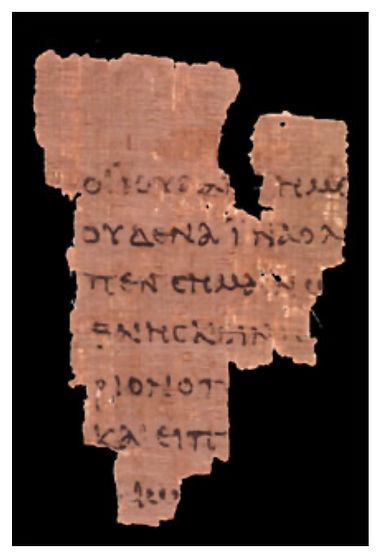
P52
The oldest existing manuscript is P52. The letter 'P' stands for papyrus, the substance or material of the scroll. This fragment is dated to AD 125 and was found in Egypt. The passage on the fragment is from the Gospel of John (18:31-33, 37-38), Jesus' dialogue with Pilate at His trial before His crucifixion (Gospels, 29). From the 2.000 manuscripts or fragments of the gospels preserved to-date, P52 is the oldest. And since this is dated to the early second century and found its way to Egypt, it follows that the original writing dates back to the first century AD. The rapid spread of the Gospel required both oral witness and written documents. Many copies of the original gospels were made and even in different languages. The Bible is well attested by its manuscript evidence.
The Gospel as the Word of God
The apostles declared the Gospel as the Word of God. Peter made this point in his first epistle: the living and enduring word of God (quoting Isaiah 40:6-8) is the gospel (see 1 Peter 1:23-25). Paul saw 'the hope of eternal life' in the gospel as 'His [God's] word' (Titus 1:1-3). The gospel Paul proclaimed to the people in Thessalonica (1 Thessalonians 1:5-8; 2:4, 8) was received as 'the word of God,' not a word of men (v 13). The gospel is not of human invention (Galatians 1:11). The gospel Paul preached is 'the word of God' (2 Timothy 2:8-9). The gospel was communicated through human agency, but it is the Word of God to humanity! When Philip the evangelist was 'proclaiming Christ' in Samaria, he was 'preaching the word' (Acts 8:4-5) as 'the good news about the kingdom of God and the name of Jesus Christ' (v 12). This proclamation of the gospel and the response of the people believing the word, was understood by the leading apostles as Samaritans having 'received the word of God' (v 14). The apostles themselves preached the gospel as 'the word of the Lord (v 25; cf., v 40). The apostles were the eyewitnesses and ministers of the word of God (Luke 1:1-4; Acts 6:2, 4). The gospel is the word of God: the message of God to humanity!
The gospel of God concerning His Son is the power of God to save; it was foretold in the prophetic Scriptures and revealed through the word of the gospel (Romans 1:1-4, 16-17; 16:25-27). Jesus' death and resurrection are 'according to the Scriptures' (1 Corinthians 15:3-4). Peter demonstrated how the events that were unfolding were in fulfilment of Scripture (Acts 2:14-39). Stephen, Philip and Paul proclaimed Christ from the Scriptures (Acts 7:1-50; 8:26-40; 17:1-4). The salvation that comes to people who hear the gospel and believe, comes from the word of/about Christ (Romans 10:8-17). Based on the gospel, people who call on the Name of Yahweh shall be saved. The apostolic witness to Jesus is the very foundation on which the church is built (Ephesians 2:19-22). It is the message of 'our common salvation' that was 'once for all handed down to the saints' (Jude 3), words spoken by the holy prophets and apostles according to the commandment of God (2 Peter 3:2). Believers are to remain in the teaching of Christ (2 John 9), abide in the truth that sets free (John 8:31-36), and by obeying it, build their house on a rock in wisdom (Matthew 7:24-27). Just as the Word of God endures forever (1 Peter 1:24-25; Isaiah 40:6-8), so do the words of Jesus, the Son of God (Matthew 24:35).
What God spoke through Moses in the Law, what the prophets spoke on God's behalf and what the apostles proclaimed through the gospel of salvation, is all part of God's Word. The Bible is the accumulation of what God has been saying and doing in human history, preserved for us, and inspired (God-breathed) by the Holy Spirit and given through human agency: people who were moved by God's Spirit. The origin of Scripture is God. The inspiration of the Bible comes from God's Spirit through certain individuals chosen by God.
But know this first all all, that no prophecy of Scripture is a matter of one's own interpretation, for no prophecy was every made by an act of human will, but men moved by the Holy Spirit spoke from God.
2 Peter 1:20-21 NASB

The Inspiration of Scripture
Both apostles, Paul and Peter, tell us that Scripture is inspired by God (2 Timothy 3:16) as individuals were moved by God to speak His words (2 Peter 1:20-21). The word Paul used is literally 'God-breathed' (Greek: theopneutos, from theos [God] and pneuma [S/spirit, breath, wind]). We may define 'the inspiration of Scripture' as the 'supernatural influence of the Holy Spirit upon Scripture writers which rendered their writings an accurate record of the revelation or which resulted in what they wrote actually being the Word of God' (Christian Doctrine, 61). The inspired Scriptures, in context, refers to the 'sacred writings' that teach wisdom and point to salvation in Christ (2 Timothy 3:15) and equip us for every good work through its instruction and correction (vv 16-17). These Scripture protect us from evil men who twist Scripture and pervert spirituality (vv 1-13). It is 'the word of truth' we are to rightly handle (2:15) and the 'sound doctrine' were are to abide in (1 Timothy 4:6-16; 6:3) according to the glorious gospel of Jesus Christ (1:5-11).
What was 'written in earlier times,' Paul maintained, was 'written for our instruction,' in order to gain 'encouragement from the Scriptures' in perseverance with hope (Romans 15:4). The Word of God instructs us, enlightens us and even warns us from choosing the wrong paths in life (Psalm 19:7-11). Scripture warns us how to behave during temptations based on what was written in a description of past history; in this case, a negative example (1 Corinthians 10:1-13). Jesus fought off the devil and temptation by 'it is written,' that is, what was written in Scripture (Matthew 4:1-11). Jesus regarding every word and letter as God's Word (Matthew 5:17-18); 'anything that the Old Testament said was what God said... having the force of God's own words. It was authoritative' (Christian Doctrine, 65). The inspiration of Scripture is the work of God's Spirit to communicate His word to us through human agency.
There are different theories of inspiration, that is, how this process actually worked. The intuition theory sees inspiration more like an 'insight' of a 'special gift,' similar to an 'artistic ability' of 'religious geniuses.' The illumination theory explains inspiration as 'an influence of the Holy Spirit' in terms of 'a heightening of their normal powers' with 'increased sensitivity' to spiritual matters and 'ability to discover truth.' The dynamic theory speaks of 'the combination of divine and human elements in the process of inspiration and of the writing of the Bible,' the Spirit directing 'the thoughts or concepts' of the authors and allowing their 'distinctive personality to come inti play in the choice of words and expressions... Thus, the person writing gave expression to the divinely directed thoughts in a way that was uniquely characteristic of him.' The verbal theory, in contrast, 'maintains that the influence of the Holy Spirit extended beyond the direction of thoughts to the selection of words used to convey the message,' each word being 'the exact word which God wants used at that point to express the message.' Finally, the dictation theory teaches that 'God actually dictated the Bible to the writers' (Christian Doctrine, 63-64).
For the biblical authors, 'the intensiveness of the inspiration' extended to 'every word, syllable, and punctuation mark as significant.' Thus, 'the inspiration of the Scripture was so intense that it extended even to the choice of particular words' (Christian Doctrine, 65). We affirm that 'inspiration was verbal, extending even to the choice of words,' that is, 'that inspiration involved God's directing the thoughts of the writers, so that they were precisely the thoughts that he wished expressed' (67). Because of the divine work of God's Spirit to guide the writing of Scripture, we can be sure that it reveals God's will and is divine instruction as a reliable source of the revelation of God and for direction in life.
The Inerrancy of Scripture
The inspiration of Scripture affirms its inerrancy, that is, 'the doctrine that the Bible is fully truthful in all of its teaching... when judged by the usage of its time, [the Bible] teaches the truth without any affirmation of error.' It is therefore, a corollary doctrine of inspiration (Christian Doctrine, 68). The three different conceptions of inerrancy are, on the one end of the spectrum, limited inerrancy, that is, the Bible is 'truthful and inerrant' for the purpose it was given, yet doesn't' include historical and scientific inerrancy, and on the other end of the spectrum, absolute inerrancy, that is, the Bible is 'fully true' even its details of scientific and historical matters. A middle view of this spectrum is full inerrancy, that is, the Bible is true in what it states and teaches, yet historical and scientific detail are 'phenomenal,' meaning, 'they are reported the way they appear to the human eye' and true in general terms and approximations (Christian Doctrine, 69-70). Even in our modern world with considerable scientific advancement and a better understanding of how the natural world works, people, including scientists, speak of the sunrise, although we know that the earth circumvents the sun, hence, the sun doesn't literally rise, it just so appears to the human eye.
The Bible is, primarily, a book of religious matters, and its message of salvation is central. Demanding modern criteria of an ancient text would be unreasonable. We need to understand any text in its historical and cultural context. We need to understanding the Bible for what it seeks to convey. Critical scholarship has long pointed out the errors in the Bible to undermine or discredit its reliability and authority. A proper look at Scripture and a fair treatment, however, shows a positive picture. The following definition and explanations are helpful: 'The Bible, when correctly interpreted in light of the level to which culture and the means of communication had developed at the time it was written, and in view of the purposes for which it was given, is fully truthful in all that it affirms' (Christian Doctrine, 72). Erickson makes the following points of explanation: we understand inerrancy for what Scripture affirms and the purpose for which it was given; we judge it in terms of what statements meant at the time and treat scientific and technical language as phenomenal; and difficulties in the biblical text 'should not be prejudged as indications of error,' because further research can shed more light on a matter and solve tensions of understudying the Bible (72-74). In conclusion, we affirm that 'the Bible is a sure source of guidance. For when correctly interpreted, it can be fully relied upon in all that it teaches. It is a sure, dependable, and trustworthy authority' (75).
The Canon of Scripture
The Canon of Scripture is the totality of the inspired and authoritative documents for the believers and the faith community. The Bible is the basis for theology. There are 39 Old Testament and 27 New Testament documents that make up the Christian Bible. The word Canon (Greek: kanon) refers to a rule, norm or yardstick, indicating 'that limits have been set by the consensus of the Christian community to the texts which may be regarded as "scriptural," and hence as authoritative for Christian theology' (Christian Theology, 160). These were not decided upon, defined or imposed by church leaders or councils, but rather recognised as inspired writings from God from very early on. Already Peter indicated the use of the technical term 'Scripture' to Paul's writings (2 Peter 3:15-16).
Yet despite having a defined body of literature, the different church traditions that have evolved in the last 2.000 years of church history is evidence to the important issue of biblical interpretation (see B6). There is general consensus across the Christian community on the centrality of Jesus Christ and His atoning sacrifice for the salvation of humanity, yet considerable differences when it comes to other matters of doctrine and application. A good guideline to handle these issues is to agree and find unity on the central matters of Christian orthodoxy and remain respectful where we disagree, with a gracious attitude of 'agree to disagree.' Love is, above all, what matters most. We should do all things in love (1 Corinthians 16:14) and our faith should be working through love (Galatians 5:6). Neither should we compromise on truth, for love rejoices in the truth (1 Corinthians 13:6). Yet we cannot compromise love for truth either.
References
Erickson, Millard J. Introducing Christian Doctrine (Second Edition; Ed. L. Arnold Hustad). Grand Rapids, MI: Baker Academic, 2001, 2004.
McGrath, Alister E., Christian Theology: An Introduction. Oxford: Blackwell Publishing, 2001.
Roberts, Mark D. Can We Trust the Gospels? Investigating the Reliability of Matthew, Mark, Luke, and John. Wheathon, IL: Crossway Books, 2007.